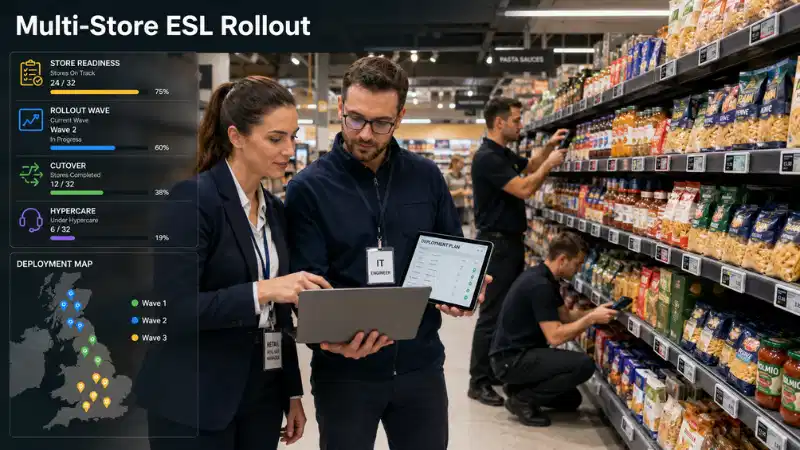
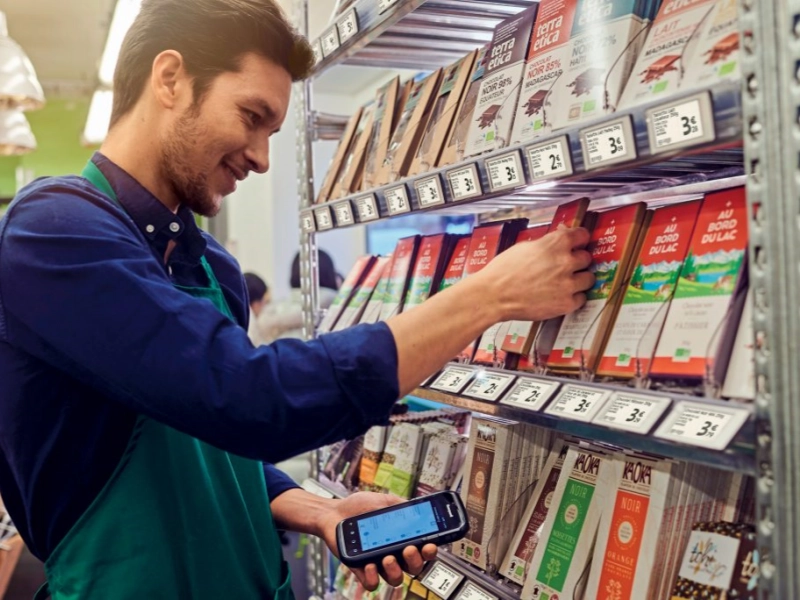
A grocery chain manager in Poland asked us last quarter for a quote on 12,000 electronic shelf labels. His first question wasn't about features or battery life. It was: "Why does a small e-ink screen cost more than an entire Android tablet?"
He's not wrong to ask. If you've been researching e-ink display costs for a retail or warehouse project, you've probably hit the same wall - vague "contact us for pricing" pages, inconsistent quotes, and zero explanation of what's actually inside that little black-and-white screen that justifies the price tag. This guide lays out what e-ink displays cost right now, why the pricing works the way it does, and how to calculate total deployment cost for an ESL project without nasty surprises six months in.
Why Do E-Ink Displays Cost So Much?
The short answer: one company controls the core technology, not many people buy it (relative to LCD), and physics makes bigger screens disproportionately expensive.
A near-monopoly on the core material. E Ink Corporation, headquartered in Hsinchu, Taiwan, holds the foundational patents on electrophoretic display film. Every major e-ink panel - Kindle screens, Remarkable tablets, the ESL tags hanging in Carrefour stores - relies on E Ink's film or a licensed version of it. In April 2025, E Ink and AUO Display Plus signed a joint venture worth TWD 390 million (~USD 11.8 million) to scale large-format EPD production at AUO's Longke facility, according to filings covered by Business Research Insights. That investment confirms both growing demand and the fact that the supply side remains concentrated. When one company owns the critical input, there's no race to the bottom on pricing.
Area-based cost scaling. LCD pricing roughly tracks diagonal measurement. E-ink tracks area. Double the diagonal, quadruple the surface that must be coated with microcapsules - each containing charged pigment particles suspended in clear fluid. More area means more material, tighter tolerances, and exponentially higher defect risk during manufacturing. A 13.3-inch e-ink display routinely costs 10–15x what a 2.9-inch panel does. Not 4–5x. That surprises every first-time buyer.
Volume gap. According to Verified Market Reports, the global e-paper display module market was valued at approximately USD 3.25 billion in 2024, projected to reach USD 6.15 billion by 2033 at roughly 7.5% CAGR. Sounds like healthy growth - until you compare it to the LCD panel market, which TrendForce estimated at over USD 120 billion in 2024. That 40:1 volume difference is the single biggest reason per-unit e-ink costs remain elevated. Fixed R&D and tooling costs get spread across far fewer panels.
E-Ink Display Price by Size: 2026 Ranges
Prices below reflect procurement reality across multiple supplier quotes at modest volumes (100–500 pieces). Display module only - panel plus driver board, no software or gateway.
| Size Category | Diagonal | Price Range (USD) | Common Retail Use |
|---|---|---|---|
| Small | 1.5" – 3.5" | $3 – $25 | Shelf-edge price tags, smart badges, bin labels |
| Medium | 4.0" – 7.5" | $30 – $120 | Product info cards, meeting room signs, pharmacy labels |
| Large | 10" – 32" | $180 – $2,500+ | Wayfinding signage, digital menu boards, whiteboards |
For ESL deployments, the 2.1" to 4.2" range is where most volume sits - our own electronic price tag lineup reflects that demand pattern. Smaller than 2 inches and the display can't comfortably show a barcode plus price plus product name. Larger than 5 inches and per-unit cost starts pushing toward LCD territory - at which point you're better off evaluating bar-type LCD screens for those specific shelf positions.
What's Inside a $12 ESL Tag? Cost Structure Breakdown
Most procurement conversations focus on per-unit price. But understanding where the money goes inside a finished label changes how you negotiate - and what corners you should never let a supplier cut.
| Component | Share of Unit Cost | Why It Matters |
|---|---|---|
| E-ink panel (EPD film + TFT backplane) | ~45% | The dominant cost. Sourced from E Ink or licensed partners. Non-negotiable quality item. |
| PCB + SoC + wireless chip | ~20% | BLE chips are cheapest (~$0.60). Sub-GHz and Wi-Fi modules cost 2–3x more. |
| Plastic casing + mounting hardware | ~12% | Custom mold tooling adds $3,000–$8,000 upfront. Standard shells eliminate this. |
| Battery (CR2450 or Li-MnO2) | ~8% | Coin cells cost under $0.80. Larger cells for 7"+ screens cost $2–$4. |
| Assembly, QC, firmware flashing | ~15% | Includes wireless pairing test and visual inspection. Cutting here causes field failures. |

That 45% EPD film share is the hard floor. You can optimize casing, choose cheaper wireless chips, simplify QC - but the panel price is set by a supply chain with very few players. Any supplier offering dramatically below-market pricing is likely cutting on panel grade or QC, which shows up as ghosting, inconsistent contrast, or premature failure in the field.
How Much Do Electronic Shelf Labels Cost Now vs. Five Years Ago?
If you evaluated ESL pricing in 2019 and decided it was too expensive, the math has changed. Based on published industry data from IDTechEx and pricing trends observed across major ESL tenders in Europe:
| Year | Typical 2.9" B&W ESL (volume) | Market Context |
|---|---|---|
| 2018 | $18 – $25 | Early adoption. Limited suppliers, small orders. |
| 2020 | $14 – $20 | BLE protocol matured. Chinese manufacturers entered. |
| 2022 | $11 – $16 | Post-COVID recovery. Walmart pilot signaled mass demand. |
| 2024 | $9 – $14 | European grocery adoption reached critical mass. |
| 2026 | $7 – $12 | Sub-$10 achievable at 10,000+ unit orders. |
Roughly 50% cheaper over eight years. Not dramatic by consumer electronics standards - LCD panels of similar size dropped 70–80% in the same period - but enough to shift the ROI equation for mid-size retailers who couldn't justify ESLs at 2018 pricing. The trajectory is clear: downward, but slowly, constrained by that concentrated supply chain.
Total Cost to Install an ESL System in a Store
The per-label price is only 30–40% of the story. Here's what a complete deployment actually costs, based on typical mid-size grocery and specialty retail projects (3,000–10,000 labels).
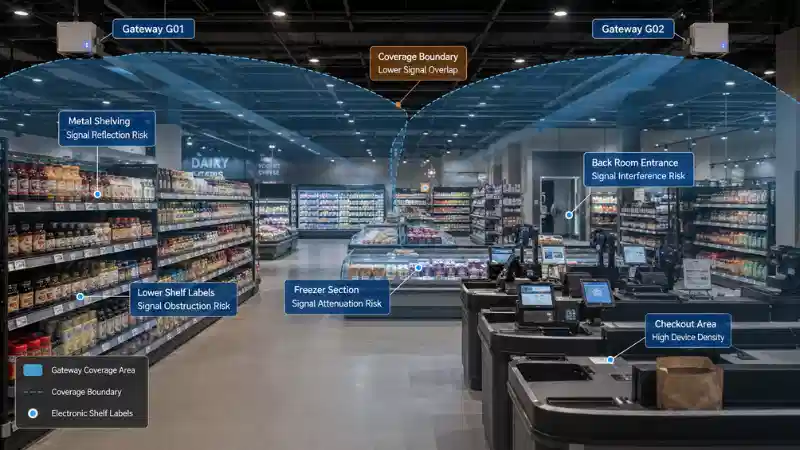
Gateways. These base stations handle wireless communication between your server and the labels. Coverage varies by protocol: a BLE gateway might cover 50–80 sqm effectively (less around metal shelving), while a 2.4GHz system covers 100–200 sqm. For a 2,000 sqm store, budget 15–30 gateways at $150–$500 each.
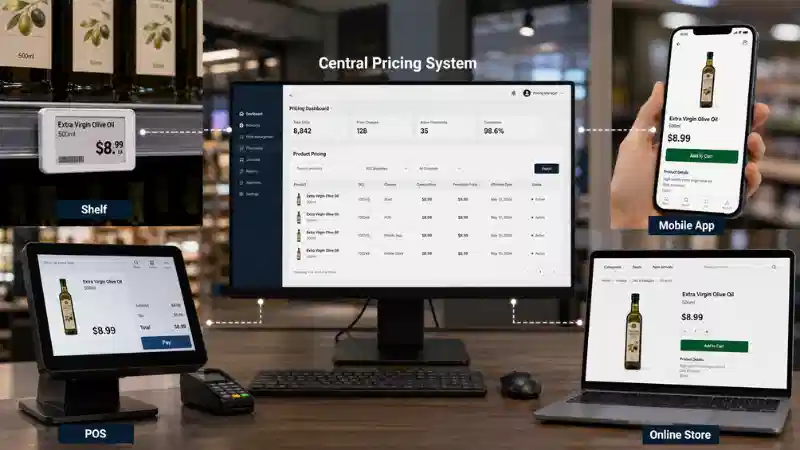
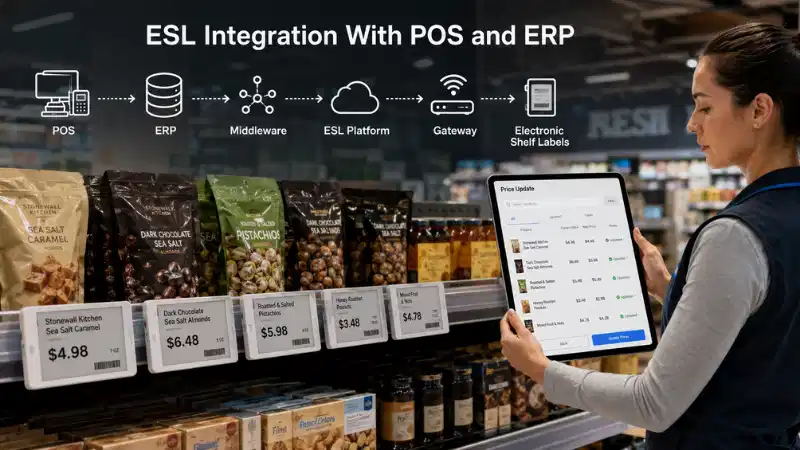
Software and POS integration. Cloud management platforms and ERP/POS connectors typically run $0.50–$2.00 per label per year. The real cost here isn't the license - it's the integration work. Data mapping, SKU matching, promotion scheduling, multi-pack pricing logic, regulatory label requirements. Budget 4–8 weeks of development time for a typical mid-size POS system. Not the "2 days" you'll hear in demos.
Mounting and installation. $0.30–$1.50 per label for clips, brackets, or adhesive rails, plus labor. Sounds trivial until you're mounting 8,000 of them.
Full project estimate. For a store with 8,000 labels: $80,000–$160,000 all-in. That's $10–$20 per label fully deployed - labels, gateways, software, integration, and installation.
E-Ink vs. LCD Shelf Displays: A Retail Price Comparison
| Factor | E-Ink ESL | LCD Shelf Screen |
|---|---|---|
| Unit cost (4" class) | $30 – $80 | $80 – $200 |
| Power | Coin cell battery, 5+ year life | Wired or rechargeable, always-on |
| Sunlight readability | Excellent - reflective, no backlight | Poor to moderate - glare issues |
| Content type | Static: price, barcode, QR, promo text | Dynamic: video, animation, rich color |
| Installation | Wireless, clip-on, no cabling | Requires power cable routing |
| 5-year TCO per unit | $40 – $100 | $120 – $300 (incl. power + maintenance) |
This isn't an either/or decision for most stores. E-ink dominates standard shelf edges - thousands of price points that change a few times per day, where wireless installation and zero power consumption are non-negotiable. LCD earns its place at endcaps, promotional zones, category headers, and anywhere video or animation drives conversion - transparent LCD display cases are one example gaining traction in cosmetics and electronics aisles. The retailers getting the best results in 2026 are deploying both, not choosing one.
Related products
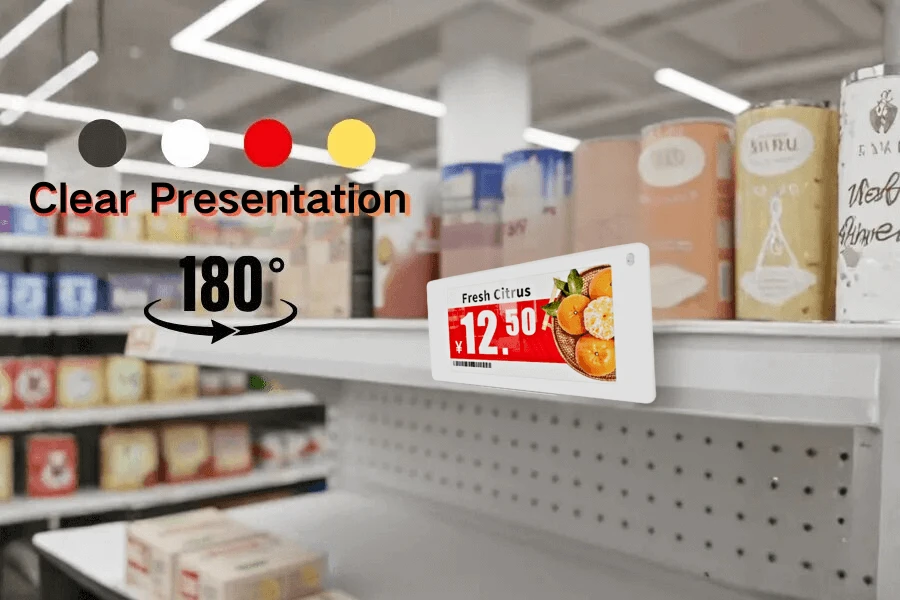
E-Ink ESL
Change prices in your back-end system, and the tags update automatically across the store within minutes. For chains with multiple locations, centralized price management suddenly becomes possible.
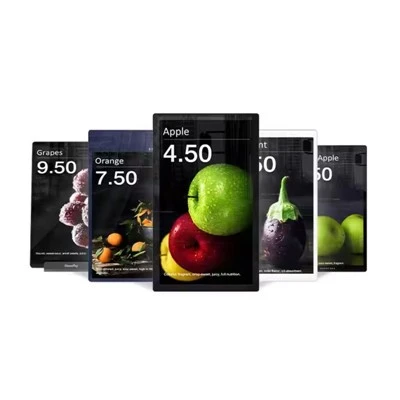
LCD Shelf Screen
all-in-one solution for dynamic retail display rack signage. Combining vibrant visuals with real-time pricing and multimedia playback, it's ideal for enhancing customer engagement and brand storytelling across cosmetics, electronics, and premium retail environments.
Common ESL Deployment Failures (and How to Avoid Them)
The marketing materials make it look easy. The reality is messier. These are the failure patterns that show up most often in post-deployment reviews.
Gateway dead zones. Suppliers quote coverage specs based on open-space testing. Real stores have metal shelving, refrigeration units, concrete pillars, and walk-in coolers - all of which degrade wireless signal by 30–50%. Labels in dead zones silently stop updating. The store manager doesn't notice until a customer complains about a wrong price. Fix: always run a physical site survey with test devices before finalizing gateway placement. Never trust the spec sheet alone.
Battery drain from over-updating. Manufacturers quote 5-year battery life based on 2–3 updates per day. Some retailers, excited by "dynamic pricing," push 10–15 updates daily. At that rate, batteries die in 18–24 months. That's 8,000 coin cells to replace in a single store, plus the labor to physically swap them. Fix: match update frequency to actual business need. Most grocery items don't need more than 2–4 updates per day. Reserve high-frequency updates for the 5% of SKUs with genuinely dynamic pricing. We covered the technical constraints in detail in our ESL refresh rate and display performance guide.
Ghosting from cheap panels. Budget e-ink displays sometimes show ghosting - faint remnants of previous content visible after refresh. It's caused by poor waveform tuning or low-grade EPD film. On a consumer e-reader you might not care. On a shelf edge with a price tag, it looks unprofessional and erodes customer trust. Fix: request samples and run 500+ refresh cycles before volume commitment. If ghosting appears after 200 cycles, walk away.
Integration surprises. The demo shows a price change syncing from POS to label in 3 seconds. Nobody mentions the 6 weeks of development work to get there - mapping your product hierarchy, handling exceptions (weight-based items, deposit fees, regional tax variations), building promotion scheduling logic, and QA testing across thousands of SKUs. Fix: budget integration as a real line item, not an afterthought.
Frequently Asked Questions
Q: How much does a single electronic shelf label cost?
A: A standard 2.9-inch black-and-white ESL costs $7–$15 at volume (5,000+ units), depending on supplier and communication protocol. Tri-color models (black/white/red) run $10–$25. Prices include the label, battery, and mounting clip but exclude gateways and software.
Q: Why are e-ink displays more expensive than LCD?
A: E Ink Corporation holds a near-monopoly on electrophoretic display film. Production volumes are roughly 40x smaller than LCD (a ~$3.25B market vs. ~$120B, per Verified Market Reports and TrendForce). And e-ink cost scales with panel area, not diagonal, making larger sizes disproportionately expensive.
Q: Are electronic shelf labels worth the investment for a mid-size store?
A: For stores with 5,000+ SKUs and frequent price changes, labor savings typically deliver ROI within 12–18 months. A European grocery chain we worked with documented 40 hours/week spent on manual label changes pre-ESL - that dropped to under 3 hours post-deployment, saving over €34,000 annually. For stores under 500 SKUs with stable pricing, the payback stretches well beyond 2 years and the case weakens considerably.
Q: What is the total cost to deploy ESLs store-wide?
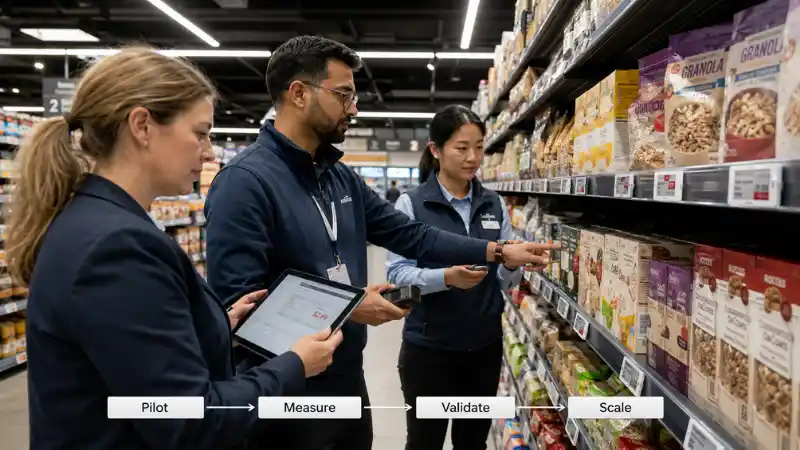
A: For 8,000 labels in a mid-size grocery store: $80,000–$160,000 including labels, gateways, software licensing, POS integration, and installation. That's $10–$20 per label fully deployed. Phased rollouts (starting with one aisle or department) reduce upfront outlay and let you validate before scaling.
Q: Will e-ink ESL prices keep dropping?
A: Yes, but slowly. The e-paper display module market is growing at roughly 7.5% CAGR through 2033 (Verified Market Reports). Major rollouts from Walmart, Carrefour, and Aldi are pushing production volumes up. But the concentrated supply chain for EPD film puts a floor under how fast prices can fall. Expect 5–8% annual declines, not the 15–20% drops you'd see in LCD.
Q: Should I choose e-ink or LCD for shelf-edge displays?
A: Use e-ink for standard shelf-edge pricing - wireless, ultra-low power, 5-year battery, works in any lighting. Use LCD for endcaps, promo zones, and high-traffic spots where video and animation drive sales. Most retailers deploy both. See our solutions overview for how the two technologies combine in a single store.
Next Steps
If you're building a business case for electronic shelf labels or evaluating the e-ink vs. LCD question for your specific store format, send us your store layout and SKU count. We manufacture both e-ink ESL tags (2.66" to 7.5") and LCD bar-type shelf displays (28" to 49.5"), and we've supported deployments across 10,000+ retail locations. We'll put together a cost estimate specific to your project - hardware, gateways, software, and installation included.